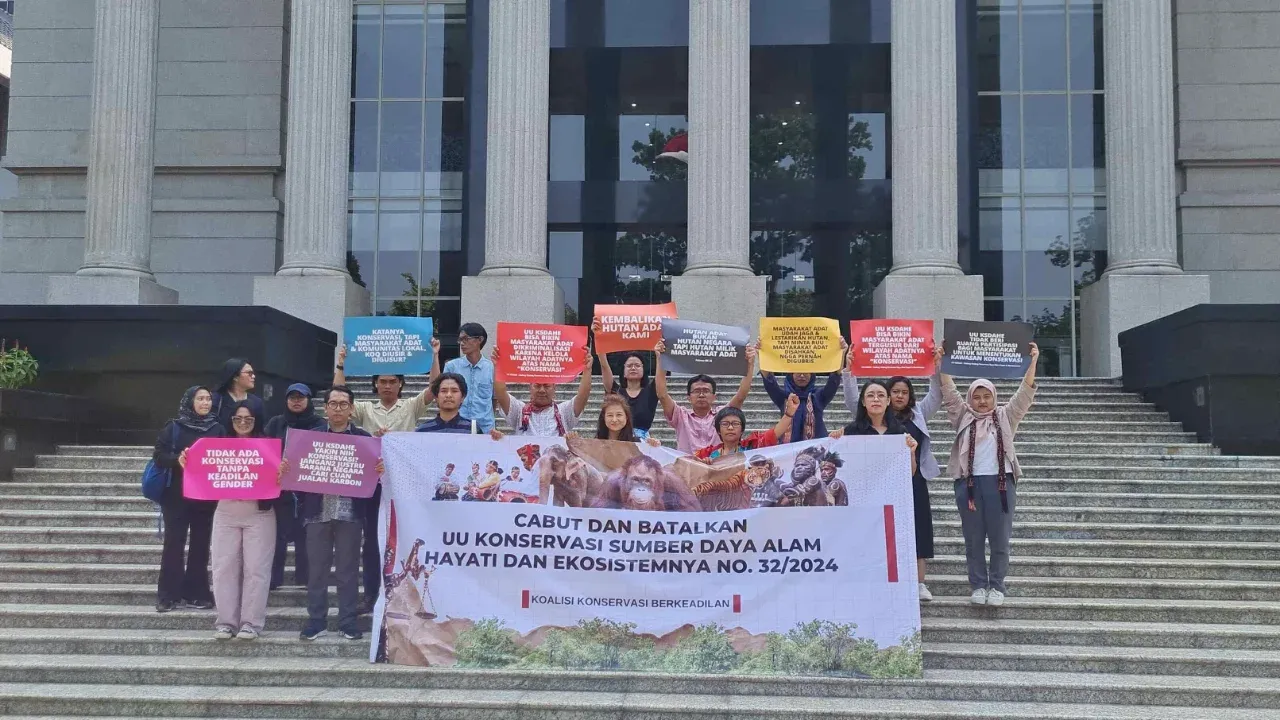
Press Release: Constitutional Court Rejects Formal Review of Indigenous Peoples and Local Communities' Petition Related to the Biodiversity Conservation Law: Public Participation Becomes Increasingly Meaningless
PRESS RELEASE
ADVOCACY TEAM FOR EQUITABLE CONSERVATION
Jakarta, July 17, 2025 – The Constitutional Court of the Republic of Indonesia rejected the formal review petition of the Biodiversity and Ecosystem Conservation Law (UU KSDAHE) submitted by three civil society organizations and representatives of indigenous peoples. This decision marks a setback in the recognition and protection of indigenous peoples and local communities in conducting conservation based on traditional knowledge and local wisdom.
The four petitioners are the Indigenous Peoples Alliance of the Archipelago (AMAN), the Indonesian Forum for the Environment (WALHI), the People's Coalition for Fisheries Justice (KIARA), and Mikael Ane, a member of the Ngkiong Manggarai Indigenous Community, NTT, who has been criminalized. The petition for judicial review is registered under Case Number 132/PUU-XXII/2024.
The Process of Forming the UU KSDAHE Was Closed but Not Problematic and Justified by the Constitutional Court
In its legal considerations, the Constitutional Court acknowledged that out of 21 (twenty-one) meetings in the First Level Discussion and 1 (one) meeting in the Second Level Discussion during the deliberation stages, only 4 (four) meetings were held openly, while the remaining 18 (eighteen) meetings, including the Formulation and Synchronization Team meetings, were held behind closed doors.
The Constitutional Court even mentioned that although the meetings were declared closed, the public could still learn about the discussions through meeting notes, either in full or in part. However, monitoring results from the Civil Society Coalition for Equitable Conservation found 20 meeting process documents that were inaccessible.
Urging Fair and Participatory Legislation
Indigenous peoples coalitions, civil society organizations, and academics call for future legislative processes to adhere to the principle of Meaningful Participation, especially on issues related to the environment, land, and natural resources.
"We appreciate the Constitutional Court's decision regarding the formal review of the UU KSDAHE that we requested. However, for us, the involvement of communities, especially Indigenous Legal Communities in the RDPU, is not sufficient to ensure meaningful participation in the formation of the UU KSDAHE. Moreover, our experience during the advocacy process for the UU KSDAHE, meeting documents and draft laws were not easily accessible, as proven in previous court proceedings, and we did not receive adequate explanations from the lawmakers regarding various problematic articles in the law. We will continue to monitor this law," asserted Cindy Julianty, Executive Coordinator of the ICCAs Working Group Indonesia.
This Constitutional Court decision sets a bad precedent for future legislative processes and increasingly sidelines the voices of vulnerable and directly affected groups, especially indigenous peoples and local communities. This decision reinforces the position of indigenous peoples as legal subjects entitled to active involvement in any policy affecting their living space, culture, and livelihoods.
"With this formal review petition, the government and the DPR must begin to reorganize an inclusive, democratic legislative process that respects the existence of Indigenous Peoples as forest and biodiversity guardians, as emphasized by the Constitutional Court in this decision that lawmakers must maximize meaningful full involvement of the community," said Syamsul Alam Agus, S.H., legal counsel for the petitioners, who is part of the Advocacy Team for Equitable Conservation.
"This Constitutional Court decision contains a paradox clearly depicted in the considerations, as on one hand, it rejects but on the other hand, it suggests lawmakers maximize participation in legislation formation through information technology, making it clear that the Constitutional Court's consideration to reject this petition is not solid and tends to be hesitant in deciding the case," said Teo Reffelsen, Legal and Advocacy Manager of WALHI.
In line with this, the Secretary-General of the People's Coalition for Fisheries Justice (KIARA) stated that:
"This Constitutional Court decision adds to the long history of law formation that ignores the principles of openness and public involvement or does not involve full, real, and meaningful participation (Meaningful Participation) from indigenous peoples and local communities living in coastal areas and small islands. This is also in line with the dissenting opinion by two Constitutional Court Judges who stated that there was a neglect of the principles of openness and public involvement in realizing the principle of Meaningful Participation in the drafting of the UU KSDAHE. Justice for all indigenous peoples and local communities to be meaningfully involved in the drafting of laws and regulations should be upheld by the Constitutional Court," emphasized Susan.
The Secretary-General of the Indigenous Peoples Alliance of the Archipelago (AMAN), Rukka Sombolinggi, stated that the absence of full and effective participation would render this law illegitimate in the eyes of indigenous peoples.
"This law may be considered legal by policymakers, and the Constitutional Court by stating that it has met the formal requirements for law formation. But for us, indigenous peoples, the process of forming the UU KSDAHE and this Constitutional Court decision do not reflect full and effective participation. This is in line with the trial facts stating that out of 21 discussions, only two were open to the public. Even then, the input from indigenous peoples and civil society was not accommodated. In our view, indigenous peoples, this UU KSDAHE is legal but not legitimate," said Rukka.
Dissenting Opinion of Constitutional Court Judges: This Petition Should Have Been Granted
There is a differing opinion (dissenting opinion) from two Constitutional Court Judges, namely Constitutional Judge Suhartoyo and Constitutional Judge Saldi Isra. These two judges stated that the process of forming Law 32/2024 was discussed in closed meetings, making it difficult for the public to know the information on the progress of the draft law discussions.
Such facts cannot be justified and should not be taken lightly in the law formation process. Because the essence of the dialogical process in the principle of Meaningful Participation cannot be realized in the drafting of laws conducted behind closed doors. This clearly violates the principle of openness in the law formation process.
In this case, the two judges emphasized that openness in the discussion stage is the culmination point of public participation realization in the law formation.
The two Constitutional Court Judges also emphasized that because there are facts that the discussion process of Law 32/2024 was conducted in closed meetings without valid reasons, impacting the neglect of the principles of openness and public involvement in realizing the principle of Meaningful Participation, the Constitutional Court should have declared that Law 32/2024 contains formal defects, thus its formation process contradicts the 1945 Constitution of the Republic of Indonesia.
Therefore, the main petition of the petitioners is considered legally justified. Or, at least, the Constitutional Court should have granted part of the petitioners' requests.
Contact:
Syamsul Alam Agus, S.H. – 08118889083
Original Document of Press Release from the Advocacy Team for Equitable Conservation

Join Our Newsletter
Berlangganan buletin kami untuk mendapatkan pembaruan terbaru, berita, acara, dan aktivitas komunitas langsung ke kotak masuk Anda.
We respect you privacy, your email is safe with us.