Publication and Analysis
Policy Briefs

Wednesday, 28 Oct 2026
Policy BriefsJoint Statement of Civil Society Organizations and Representatives of Indigenous Peoples and Local Communities
Negotiations on the working procedures of the Subsidiary Body on Article 8(j) (SB8J) towards COP17 risk reducing the achievements of participation and leadership of Indigenous Peoples built through the Working Group on Article 8(j). Civil society organizations and representatives of Indigenous Peoples and Local Communities urge Indonesia to maintain the Indigenous Co-Chair mechanism and the representation of seven socio-cultural regions.
Tuesday, 23 Jun 2026
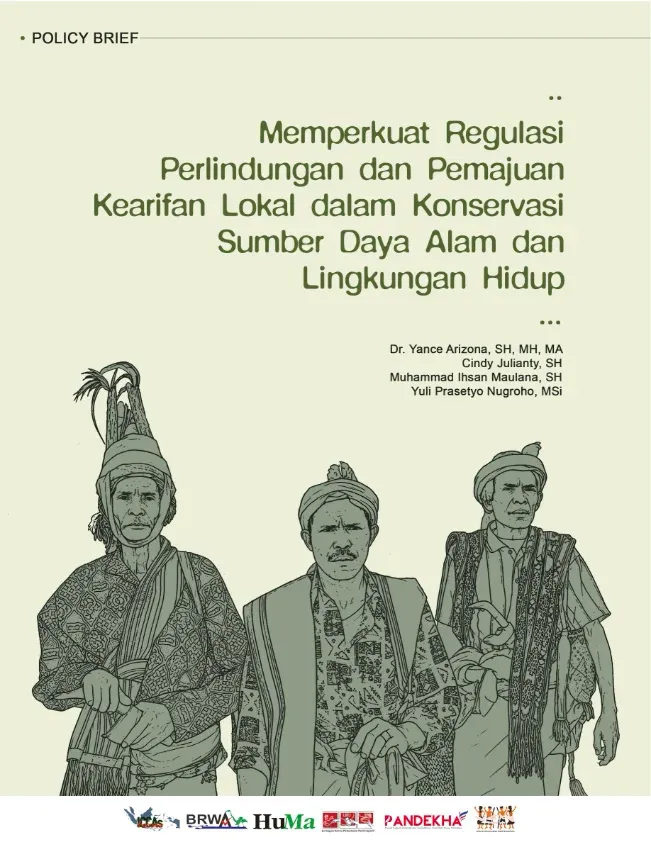
Policy BriefsStrengthening Regulations for the Protection and Advancement of Local Wisdom in Natural Resource and Environmental Conservation
Ministerial Regulation of Environment and Forestry No. 34/2017 is considered ineffective in strengthening the recognition and protection of local wisdom. After about nine years in effect, only one community has received recognition through this scheme, while Indonesia has the potential for community-managed conservation areas of more than 29.5 million hectares.
Saturday, 16 May 2026
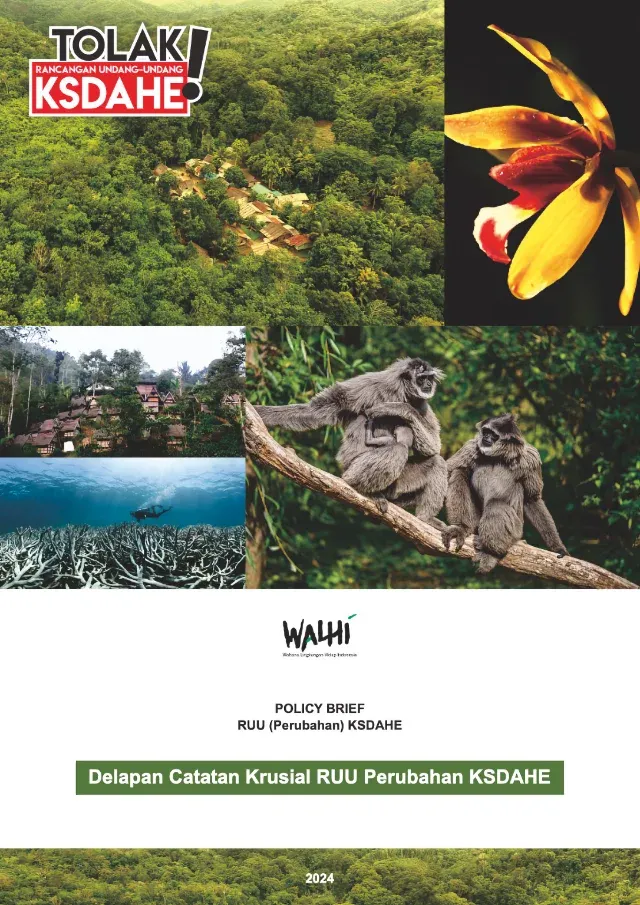
Policy BriefsEight Crucial Notes on the Draft Amendment to KSDAHE
The Living Planet & IUCN 2022 report shows a biodiversity crisis: wildlife populations have declined by 69% globally. In Indonesia, 1,225 species are threatened with extinction due to land exploitation, climate change, and IUUF.
Saturday, 16 May 2026
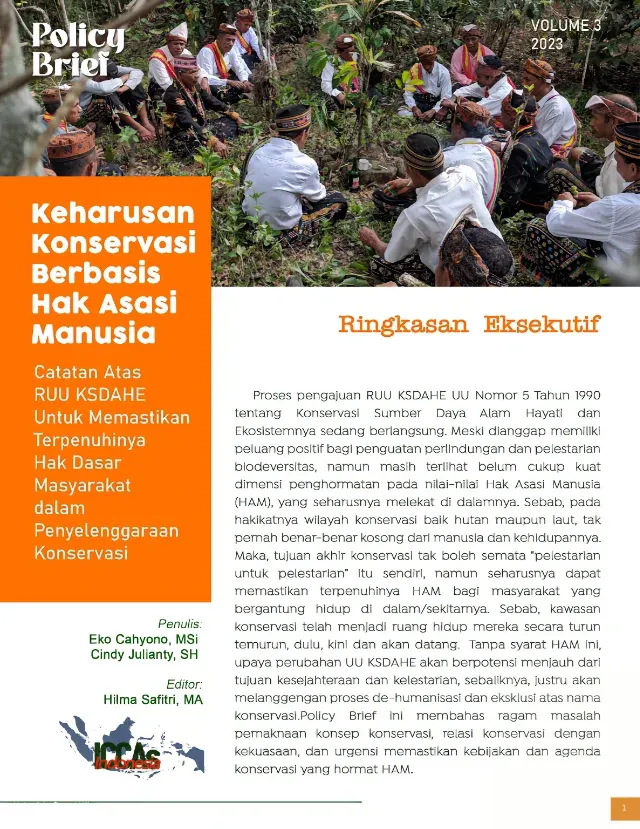
Policy BriefsThe Necessity of Human Rights-Based Conservation
The KSDAHE Bill has the potential to strengthen conservation, but it does not yet emphasize human rights. Conservation areas are living spaces for communities. Policies need to ensure human rights to prevent exclusion in the name of conservation.
Book and Research

Wednesday, 18 Nov 2026
Book and ResearchWhen Nature Becomes Numbers: A Critical Look at Biodiversity Credits and Offsets
The development of biodiversity credit and offset as conservation financing mechanisms raises issues related to the commodification of nature, the effectiveness of ecosystem restoration, and the protection of Indigenous Peoples' and Local Communities' rights. The assumption that biodiversity loss can be compensated through protection or restoration in other areas risks ignoring ecological complexity and perpetuating environmentally damaging activities. A fair conservation financing approach should prioritize damage prevention, recognition of community rights, and funding mechanisms that do not rely on biodiversity trading.

Wednesday, 18 Nov 2026
Book and ResearchDigital Sequence Information and Justice in Genetic Resource Governance
The development of Digital Sequence Information (DSI) opens up opportunities for the utilization of genetic information for research and technology development, while also presenting challenges related to data sovereignty, traceability of the origin of genetic resources, and equitable benefit-sharing. Strengthening DSI governance is important to ensure that information openness respects the rights of countries as well as Indigenous Peoples and Local Communities who contribute to the preservation of genetic resources and traditional knowledge.

Wednesday, 18 Nov 2026
Book and ResearchMobilizing Resources, Empowering Biodiversity Stewards
Biodiversity financing is not only about the amount of funds available, but also access, benefit distribution, and authority in its management. Strengthening direct finance, recognizing tenure rights, and equitable financing governance are important to ensure Indigenous Peoples and Local Communities have control over resources in preserving biodiversity.

Wednesday, 18 Nov 2026
Book and ResearchBeyond the 30x30 Target: What Does It Mean for Indigenous Peoples and Local Communities?
Achieving the global 30x30 conservation target is not enough to be measured by the expansion of conservation areas, but must also consider management effectiveness, governance equity, and the protection of the rights of Indigenous Peoples and Local Communities. The implementation of this target needs to ensure the recognition of tenure rights, respect for community management systems, and recognition of community-based conservation contributions without undermining community authority over their territories.
Technical Notes

Friday, 20 Nov 2026
Technical NotesRecommendations for the Government of the Republic of Indonesia at the 4th Meeting of the Subsidiary Body on Implementation of the Convention on Biological Diversity
WGII urges the recognition of Indigenous Peoples' rights in CBD negotiations. KM-GBF and Indonesian law support inclusive conservation that aligns traditional rights with global biodiversity commitments.

Friday, 20 Nov 2026
Technical NotesRecommendations for the Government of the Republic of Indonesia for the 16th Conference of the Parties (COP-16) of the Convention on Biological Diversity (CBD)
The importance of inclusive participation in IBSAP, protection of traditional knowledge/DSI, tenure rights indicators in KM-GBF targets, and funding access for conservation actors in Indonesia.

Friday, 20 Nov 2026
Technical NotesPolicy Recommendations for a Transformative and Inclusive NBSAPs in ASEAN and Timor Leste
The 2022 KM-GBF mandates inclusive NBSAP revisions. While groups like IPLCs and youth lead conservation, financial and technical gaps persist, requiring rights-based and gender-responsive governance.

Thursday, 19 Nov 2026
Technical NotesRecommendation Paper from the Peoples' Conservation Summit (PCS) for the Government of the Republic of Indonesia at COP17 CBD
Recognition and protection of the rights of Indigenous Peoples and Local Communities are essential in realizing equitable biodiversity governance. Through the results of the Peoples' Conservation Summit (PCS) 2026, a number of strategic recommendations are encouraged to strengthen the recognition of management areas, protection of traditional knowledge, meaningful participation, and equitable conservation funding access in national policies and Indonesia's commitments at COP17 CBD implementation.
ICCA Status infographic
Thursday, 21 May 2026
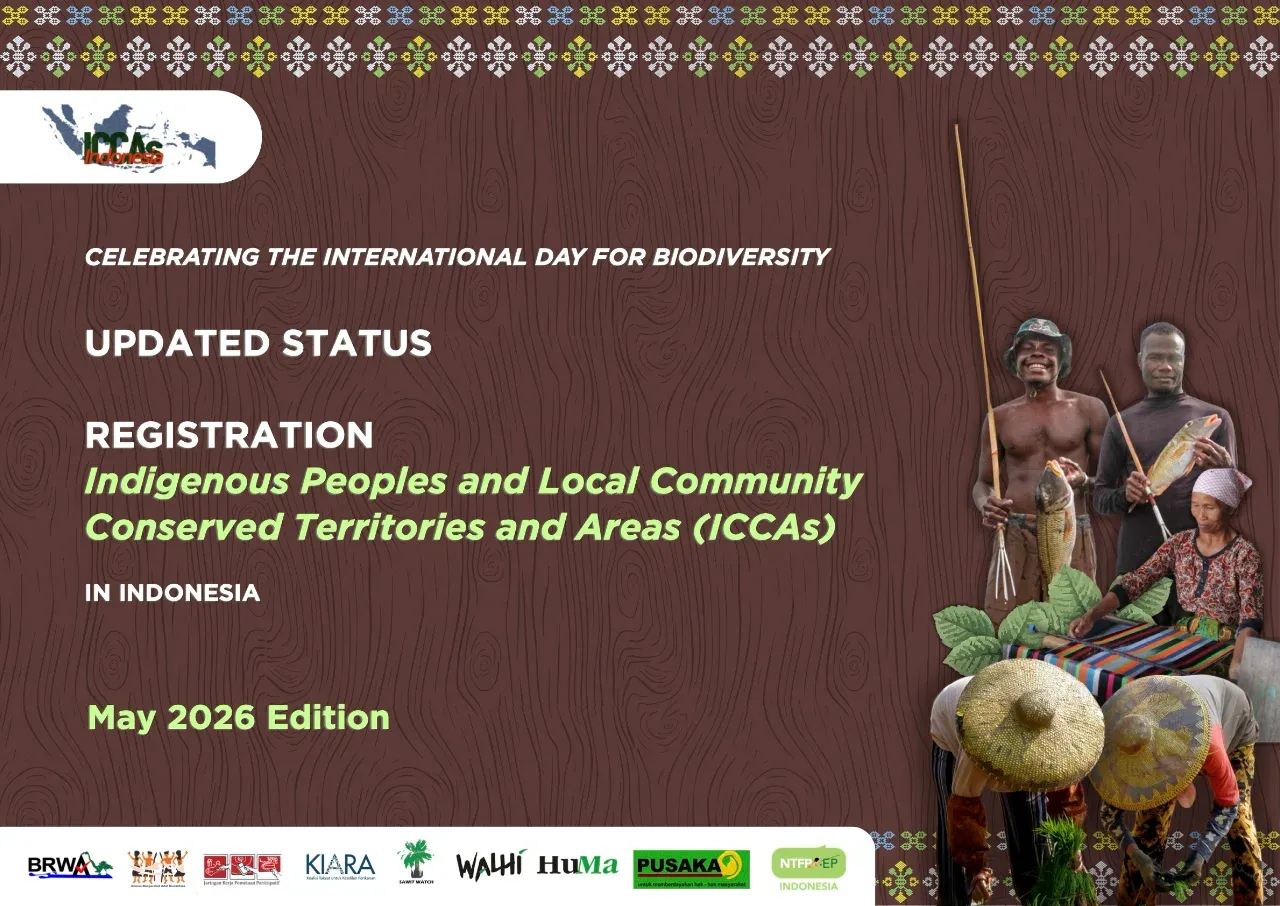
ICCA Status infographicIndigenous Peoples and Local Community Conserved Territories and Areas - May 2026 Edition
As of May 2026, the total area of the National ICCAs Registration reaches 1,010,430.68 hectares with a distribution of 527 ICCAs points managed
by 192 Indigenous Peoples and Local Communities.
Wednesday, 21 May 2025
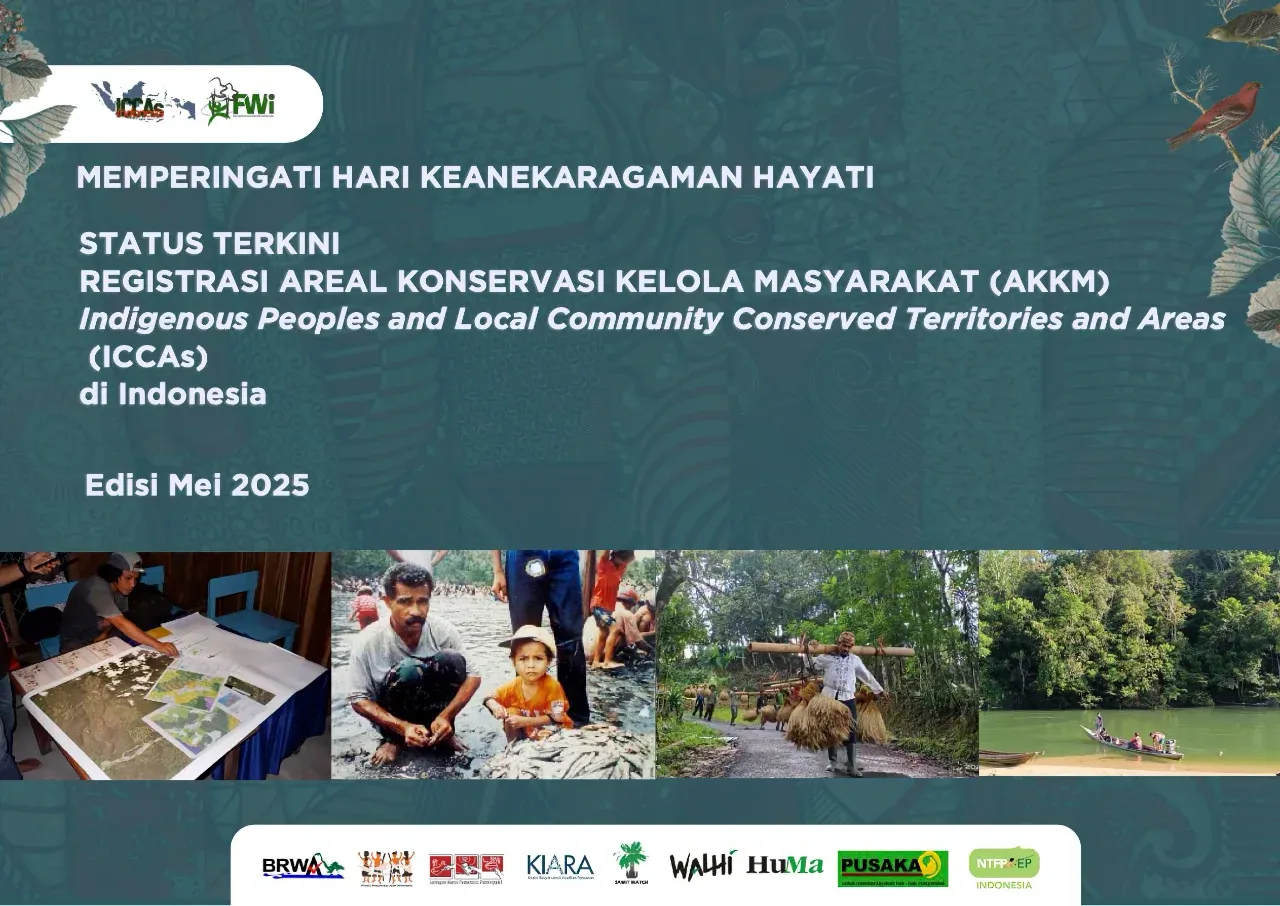
ICCA Status infographicIndigenous Peoples and Local Communities Conserved Territories and Areas Registration - May 2025 Edition
As of May 2025, the total area of the National ICCAs Registration reaches 647,457.49 hectares spread across 293 indigenous and local community areas.

Join Our Newsletter
Berlangganan buletin kami untuk mendapatkan pembaruan terbaru, berita, acara, dan aktivitas komunitas langsung ke kotak masuk Anda.
We respect you privacy, your email is safe with us.