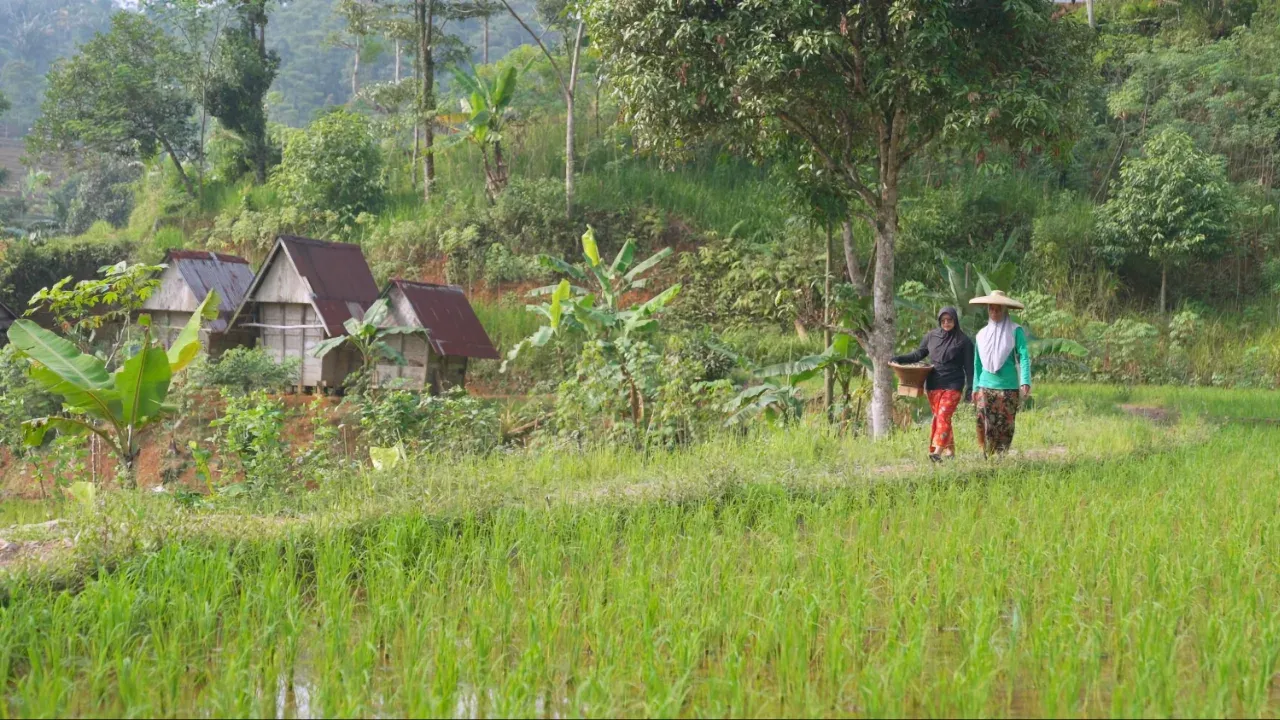
Pasir Eurih Narrative: Relearning "Conservation"
Because the forest is the heart. When it stops beating, our life's balance is uprooted
Planning, methodology, and analysis in every development activity have become prerequisites that are also believed in conservation. But planning for what and for whom? What is the theory of change? And whose reality is considered in conservation? Clearly, these are just a few questions that will determine how conservation is desired by certain parties; not how it should operate within the socio-cultural order of society.
Pasir Eurih Narrative is a small part of our efforts to capture cultural realities and articulate critical views on the concept of conservation. It raises questions about for whom conservation is conducted, how the planning process is carried out, and whose reality is considered. Teh Opah, one of the indigenous youth of Kasepuhan Pasir Eurih, will invite us to rethink that ultimately, conservation will mean nothing without respect for the rights, traditions, and knowledge of Indigenous Peoples and Local Communities themselves.
Not far from the capital province, we can see how the actions and narratives of the Indigenous People of Kasepuhan Pasir Eurih utilize the available management space and life. Kasepuhan Pasir Eurih is located in Lebak Regency, Banten, where the community has principles of forest and land use according to natural conditions, one of which is lebak caian (lowland for water storage). The diversity of values and traditions of the Indigenous People of Kasepuhan is also evident in the protection of areas, which adhere to Tatali Paranti Karuhun, or the principles of the community in Kasepuhan Pasir Eurih. "Gunung kayuan, lamping awian, lebak sawahan, legok balongan, datar imahan", which means mountains should be planted with trees, sloping land with bamboo, lowlands with rice, water reservoirs (embung) made into ponds, while flat areas are for settlements.
Furthermore, there is a wangsit kokolot kasepuhan regarding Community Managed Conservation Areas (AKKM) or ICCAs in Pasir Eurih, which states "Gunung Bongkok, pikeun kahirupan jeung kahuripan", where the location of Gunung Bongkok functions for kahirupan; or a place for farming, food, and maintaining food security. Meanwhile, kahuripan means to preserve water sources and disaster mitigation. The type of AKKM located in the Gunung Bongkok area is divided into three, including Leuweung Tutupan, Leuweung Titipan, and garapan. Leuweung tutupan is part of leuweung titipan, which may be cultivated by the community under certain conditions, according to mutual agreement. Leuweung tutupan also functions as a water catchment area and water source that must be protected. Meanwhile, leuweung titipan is a protected area that cannot be cultivated; it is sacred to the Indigenous People. In this area, there are usually sacred sites such as haji stones or pillar stones (ancestral graves). Then, leuweung garapan is located at the foot of the mountains, or directly below leuweung titipan. Usually, leuweung garapan is marked by gentle slopes and rocks, including springs, mixed gardens, or huma gebrugan practices; the practice of planting huma rice cooperatively (gebrugan) for about 6 months until harvest, with a shifting period of one to five years to different land.
In their daily lives, the Indigenous People of Kasepuhan Pasir Eurih not only rely on traditional knowledge but also adopt several changes that occur in each era. For example, the materials used to build houses, leuit, and so on, including technical and non-technical skills in land management, as well as the rites they believe in, are also sourced from the wisdom and spiritual values of the Indigenous People. Economically, the community in Kasepuhan Pasir Eurih also utilizes Non-Timber Forest Products (NTFPs) from palm trees, which are then processed into palm sugar. Additionally, other benefits seen from practices passed down through generations by the community include reduced land conflict from boundary and function arrangements, learning spaces for young indigenous generations in Kasepuhan Pasir Eurih, and traditions maintained as part of collective protection of nature, identity, and inseparable spirituality.
Therefore, it is important for us to revisit or narrate what we need in conservation practices? Can it be developed holistically? How to bring forth innovations that can fairly position traditional and modern knowledge? This is an opportunity for us to share knowledge and preserve protective practices that live within Indigenous Peoples, for a future for all. Would you like to join in this learning and action together?
#InclusiveConservation #ICCAsIndonesia

Join Our Newsletter
Berlangganan buletin kami untuk mendapatkan pembaruan terbaru, berita, acara, dan aktivitas komunitas langsung ke kotak masuk Anda.
We respect you privacy, your email is safe with us.