A Trilemma: The Designation of Meratus National Park from the Perspectives of Human Rights Justice, Morality, and Ethics
Antiquated Conservation Hegemony
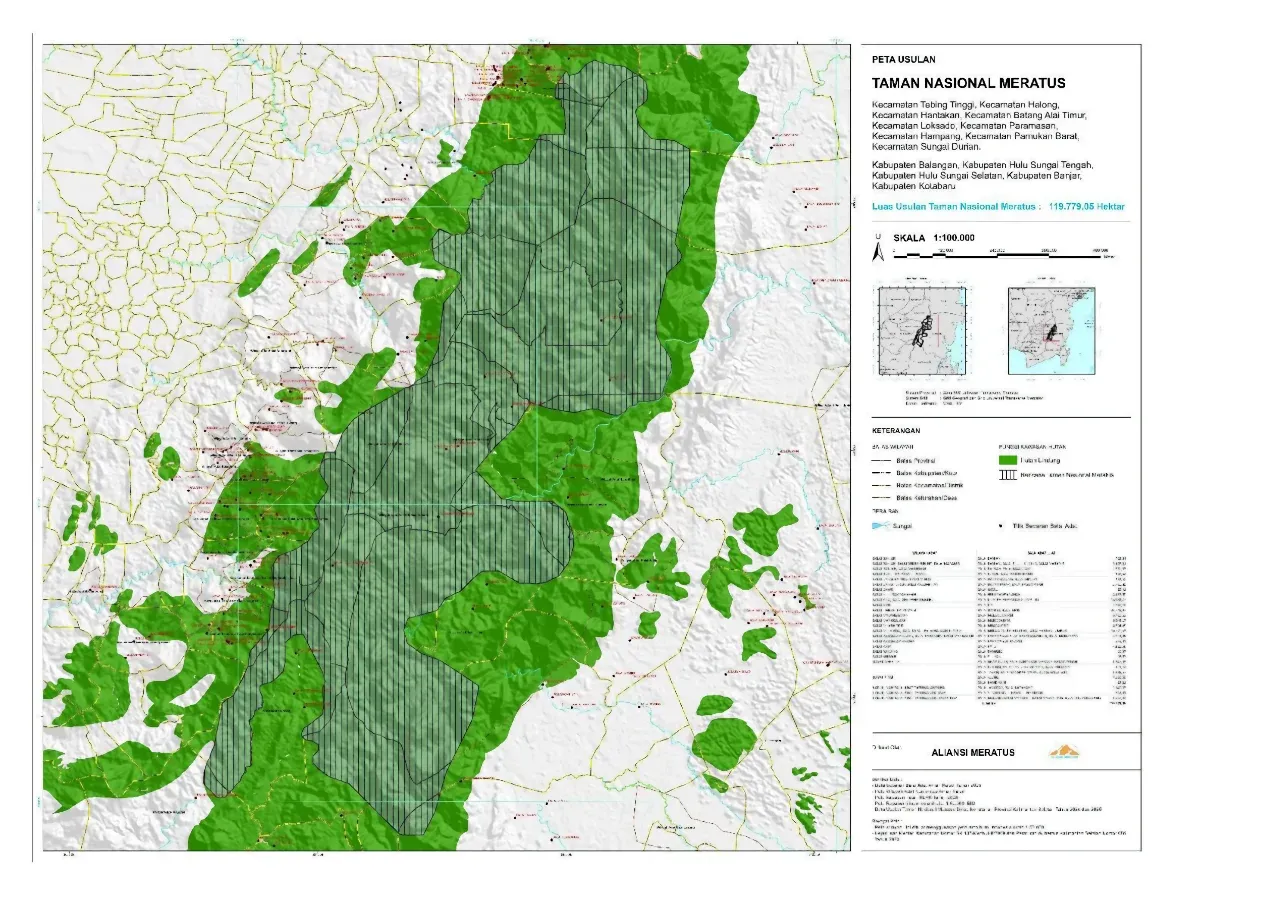
Since September 2024, the Ministry of Environment and Forestry (MoEF) has conducted preparatory meetings to include the Meratus Mountains in the list of new National Parks to be designated, alongside the eight existing National Parks in the Kalimantan region. These meetings discussed several feasibility studies to convert the status of the Protected Forest (Hutan Lindung) in the Meratus Mountains into a National Park. This initiative to change the forest area’s function aimed to increase the intensity of forest management in the Meratus Mountains and to maintain land cover, which is reportedly unchanged over the last 10 years.
In fact, the Meratus Mountains, spanning nine regencies in South Kalimantan, have faced tangible threats of destruction since the 1980s. Notably, when PT Mantimin Coal Mining (MCM) conducted coal mining exploration stages in 2009, culminating in the issuance of the Decree of the Minister of Energy and Mineral Resources (ESDM) No. 441.K/30/DJB/2017 regarding the Adjustment of the Production Operation Activity Stage of PT MCM’s Coal Mining Concession Work Agreement.
The expansion of coal mining and palm oil plantations is clearly a worrying threat to ecosystem sustainability and socio-cultural reproduction, particularly in the Meratus Mountains region. Besides, the Secretary General of the MoEF (2023) identified that 90% of palm oil companies are indicated to be operating within forest areas and have processed permits. Furthermore, 200,000 hectares of illegal palm oil plantations are known to exist within Protected Forests (HL) and Conservation Forests (HK). This certainly undermines the status and value of the area, which should function to protect the ecosystem and existing species diversity. The expected transparency and accountability are also not reflected in public information provided by the government; for example, regarding the number of palm oil business actors in the Meratus Mountains area, or the nature and process of National Strategic Projects (Proyek Strategis Nasional) development in the PT MCM mining area in Hulu Sungai Tengah, and so forth.
The Wave of Rejection Against the Meratus National Park
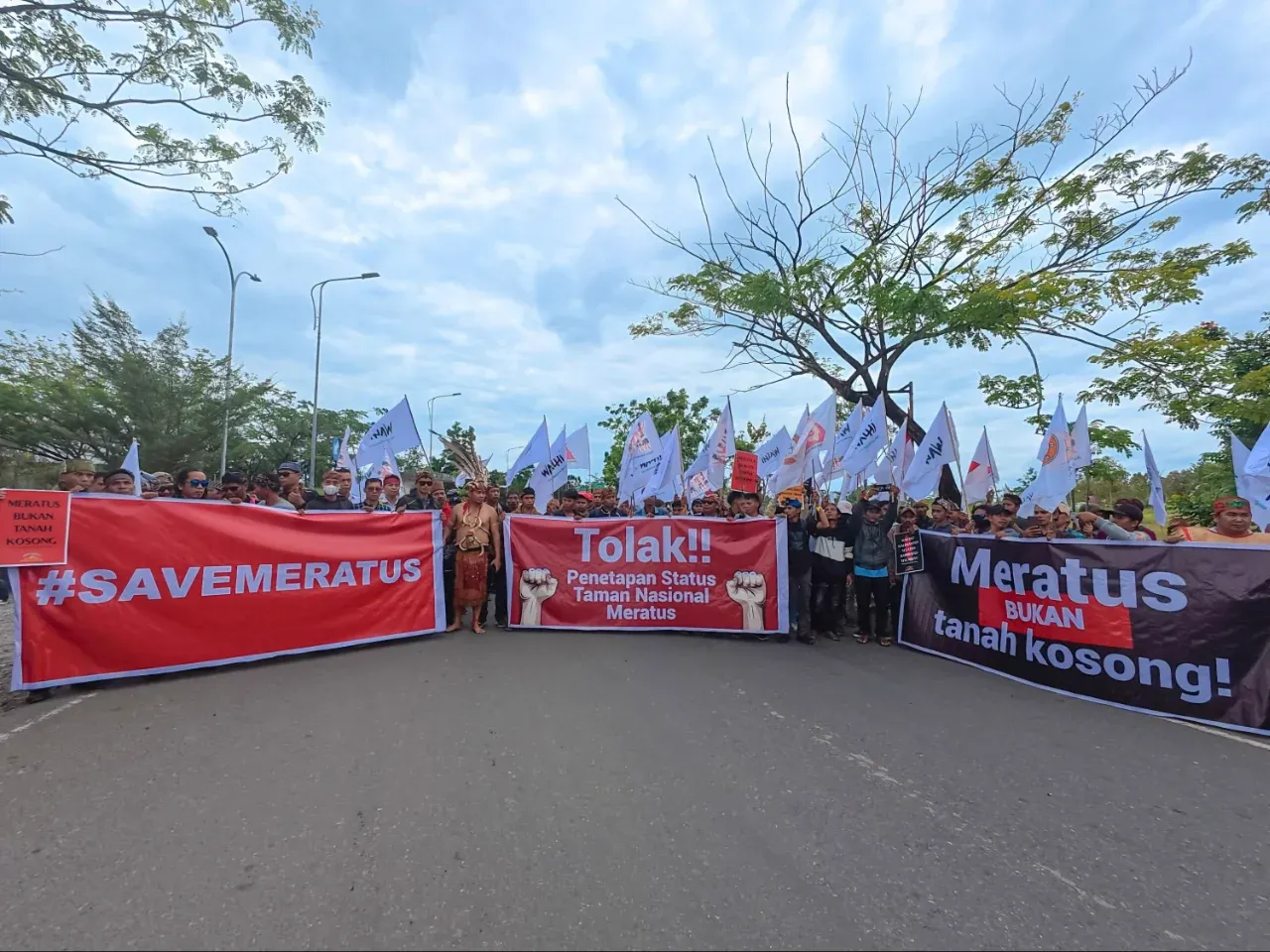
On August (2025), the Meratus Alliance held an open consolidation in response to the South Kalimantan Provincial Government’s proposal to designate the Meratus customary territory as the Meratus Mountains National Park. The Alliance, consisting of Indigenous Peoples’ communities, Local Communities, and several Civil Society Organizations, asserted that the National Park proposal ignores the very principles and existence of Indigenous Peoples and Local Communities who have inhabited the Meratus Mountains for generations. This proposal has actually been circulating for three decades, yet to date, it has not involved the people living in Meratus in the planning process.
According to Ihsan Maulana, Advocacy and Campaign Manager of the Working Group ICCAs (Indigenous and Community Conserved Areas) Indonesia (WGII), the proposal for the Meratus Mountains National Park will lengthen the list of conflicts in Conservation Areas that Indigenous Peoples and Local Communities have experienced over the last few decades. Moreover, the new Law on the Conservation of Living Natural Resources and Their Ecosystems (KSDAHE), specifically Article 9 Paragraph 2, creates systemic ambiguity regarding the dispossession of rights. The article states, “In the event that Every Person holding land rights in a Preservation Area is unwilling to carry out Conservation of Living Natural Resources and Their Ecosystems activities as referred to in paragraph (1), the person concerned must release land rights by receiving compensation.” It is clear that this will legitimize the government to reclaim areas previously owned and inhabited by Indigenous Peoples and/or Local Communities under the pretext of Conservation Area designation. Furthermore, there are no Free, Prior, and Informed Consent (FPIC) mechanisms or conflict resolution procedures within the existing legal regulations.
Consequently, the Meratus Alliance pushed for a series of joint actions and position statements, published as the “Meratus Resolution.” If this National Park is designated, it potentially disregards the position and biocultural diversity protected by Indigenous Peoples and Local Communities because the government possesses several legal foundations, such as Presidential Regulation No. 5 of 2025, the Memorandum of Understanding (MoU) between the Ministry of Forestry and the Indonesian National Armed Forces (TNI) for forest area enforcement, and Law No. 32 of 2024 on KSDAHE, which will unhesitatingly implement derivative policies. Therefore, the National Park concept will limit community access to living spaces and natural resource management, ultimately threatening the overall quality of life of the community. Considering that farming practices in Meratus are part of their spiritual manifestation, not merely activities to meet economic needs, the zoning proposed in this National Park still positions humans as entities that must seemingly be separated from the conservation agenda.
However, data from the State of Indonesia’s Forests 2024 shows that forest management within areas held by Indigenous Peoples and Local Communities has been proven to reduce deforestation rates by 30-50%. Thus, tenurial certainty, legal reform, and other forms of access to justice become inevitable prerequisites for maintaining the sustainability of remaining forests and ecosystems.
Does Justice Exist?
In practice, the discourse surrounding justice is often far removed from the realities unfolding within the socio-cultural fabric of society. For what purpose, and to whom, is justice being discussed? What can rightfully be considered just when there is an absence of moral responsibility to provide the public with access and legal justice; even while our constitution explicitly guarantees the protection of these fundamental rights? How do institutional capacities and power dynamics allow for a process of meaningful public participation?
Therefore, participatory mechanisms, specifically regarding Indigenous Peoples and Local Communities, must position them as primary actors in equitable conservation. Indigenous Peoples are not mere “diplomatic tools” to be touted in speeches or on international podiums. They have long practiced community-based conservation models that respect human rights, principles of diversity, and the ecological and spiritual integrity that form their very foundation. Furthermore, public participation and benefit-sharing constitute one of the five transformation schemes recently championed by the Task Force on Innovative Financing for National Parks and Iconic Species Conservation. With strong policy coherence and political awareness, we must anticipate the various risks and dynamics that will arise in the management of conservation areas and National Parks. This should include ensuring that the government, communities as rights-holders, academics, and relevant operational units prioritize inclusive conservation approaches and models: from, by, and for the people.

Join Our Newsletter
Berlangganan buletin kami untuk mendapatkan pembaruan terbaru, berita, acara, dan aktivitas komunitas langsung ke kotak masuk Anda.
We respect you privacy, your email is safe with us.