Press Release: Unleashing the Potential: 29 million hectares of Indigenous Peoples and Local Community Conserved Territories and Areas[
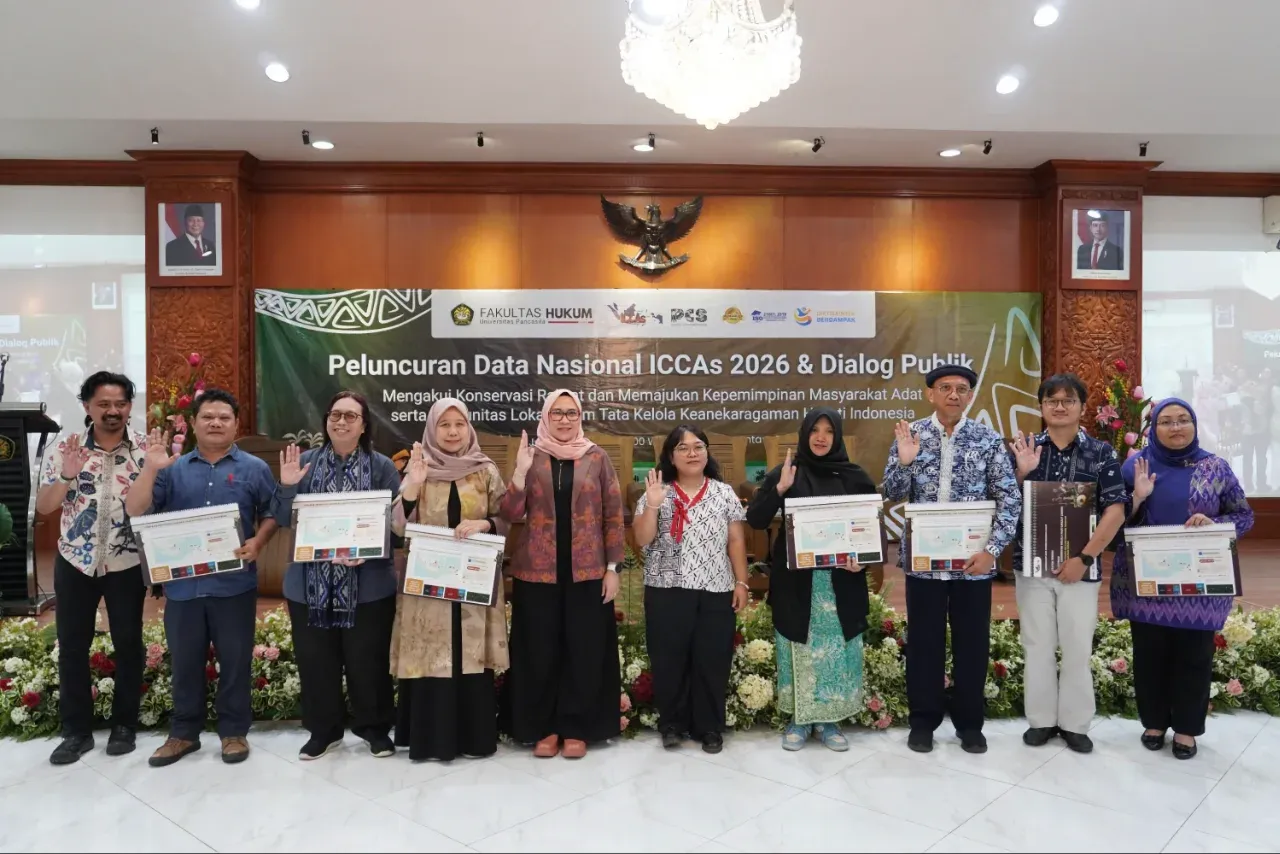
(Jakarta, June 5, 2026) The Working Group ICCAs Indonesia (WGII) has announced the latest developments in the registration of Indigenous Peoples and Local Community Conserved Territories and Areas (ICCAs) in Indonesia.
As of May 2026, 527 ICCA sites have been officially registered on a national scale. These areas cover a total of 1,010,430.68 hectares and are actively stewarded by 192 rightsholder communities, comprising 169 Indigenous communities and 23 local communities.
Beyond these currently registered areas, recent spatial analyses of Indigenous and community-managed lands have unveiled a massive, untapped potential: an additional 29,545,401.06 hectares of ICCAs spread across various Indonesian landscapes. This data underscores a profound reality, biodiversity conservation led by Indigenous Peoples and local communities in Indonesia is vastly more extensive than previously recognized.
Papua holds the largest potential for ICCAs in the country, encompassing approximately 11.67 million hectares, while Kalimantan currently boasts the largest footprint of nationally registered ICCAs, reaching 671,323.60 hectares (roughly two-thirds of the registered national total).
According to Lasti Fardilla Noor, Knowledge Management Manager of WGII, these figures reaffirm the tangible contributions of these communities to Indonesia’s biodiversity. She noted that 69.3% of ICCA territories intersect with high-conservation-value areas, including forests, peatlands, karst systems, savannas, mangroves, seagrass beds, coral reefs, and Key Biodiversity Areas (KBAs). Furthermore, these territories serve as critical habitats for approximately 77% of Indonesia’s bird species diversity.
Crucially, at least 240 plant and animal species recorded within these ICCA territories are currently classified as threatened by the IUCN.
“These findings demonstrate that conservation driven by Indigenous Peoples and local communities is not merely a normative claim, but is reflected in concrete ecological indicators. However, the significance of ICCAs extends beyond the presence of endangered species. These territories also harbor at least 2,845 plant species utilized by communities for food, medicine, construction, rituals, and other necessities, guided by traditional knowledge passed down through generations.” - Lasti Fardilla Noor, WGII
The Underlying Threat: Tenure Uncertainty
While the conservation success of ICCA practices in Indonesia is highly encouraging, a significant challenge remains: tenure uncertainty. A staggering 92.5% of registered ICCAs are located within state forest areas.
The potential ICCA footprint trapped within these state forest areas is estimated to exceed 23.36 million hectares. Beyond overlapping territorial claims, ICCA lands also frequently intersect with forestry, plantation, and mining permits. In potential ICCA areas alone, these developmental overlaps amount to more than 5.5 million hectares.
Cindy Julianty, Executive Coordinator of WGII, highlighted that extractive development pressures pose a severe threat to community-based conservation. This is despite robust global evidence, and formal recognition by the Kunming-Montreal Global Biodiversity Framework (KM-GBF), that Indigenous and Traditional Territories are highly effective approaches that directly contribute to global conservation targets.
“Therefore, the launch of the National ICCA Data isn’t just about presenting numbers; it highlights how many Indigenous and community-managed areas actively contribute to biodiversity conservation yet still lack adequate legal recognition.” - Cindy Julianty, WGII
A Socio-Ecological Perspective: More Than Just Maps
Wiwin Indiarti, a representative of the Indigenous Peoples of Osing in Banyuwangi, emphasized that Indigenous conservation is a living practice embedded in daily life, local terminology, and intergenerational traditions. She cited ngrumat sumber tradition, a practice of nurturing and protecting water springs, which is intrinsically linked to safeguarding local flora, like betung bamboo.
“What must be protected is not only the practice but also the territory, including the language, terminology, and accompanying values. Because that is where our knowledge system lives and where the relationship between humans and nature is forged.” - Wiwin Indiarti, the Indigenous Peoples of Osing.
This perspective is echoed by the scientific community. Dedi Supriyadi Adhuri, a researcher at the National Research and Innovation Agency (BRIN), noted that conservation must be understood as a socio-ecological relationship, not just an effort to keep areas “pristine” and isolated from human touch, an outdated approach that frequently sparks conflict.
He stressed the importance of ICCA documentation in translating oral traditions into actionable policy. This is further supported by Imam Mas’ud from JKPP (Indonesian Community Mapping Network) and Geger Riyanto, an Anthropology academic at the University of Indonesia, who champion participatory mapping as a vital instrument to visualize Indigenous Peoples’ territories not just as boundary lines, but as living, breathing socio-ecological spaces.
The Path Forward: Policy and Recognition
To bridge the gap between ecological reality and legal standing, several key steps are being advocated by state and community leaders. Setyo Anggraini from the Ministry of Agrarian Affairs and Spatial Planning (ATR/BPN) emphasized the need to integrate customary territories into formal land administration, including the registration of customary (ulayat) lands. Then, Erasmus Cahyadi, Deputy Secretary-General of AMAN (Indigenous Peoples Alliance of the Archipelago), urged the government to pass the long-stalled Indigenous Peoples Bill. “At the very least, there must be a legal instrument that empowers Indigenous Peoples to fight for their rights,” he stated.
Representatives from both the Ministry of Marine Affairs and Fisheries and the Ministry of Environment agree that recognizing local wisdom is paramount.
“Moving forward, there needs to be stronger recognition and protection for communities, traditional knowledge, and local wisdom as vital parts of our biodiversity conservation efforts. We are currently drafting a roadmap for the advancement and protection of local wisdom.” - Inge Retnowati, Director of Biodiversity Conservation, Ministry of Environment
Ultimately, the 2026 National ICCAs Data paints a clear picture: Indigenous Peoples and Local Communities are not merely passive beneficiaries of conservation. They are the primary actors actively safeguarding Indonesia’s biodiversity. Recognizing their territories, traditional knowledge, and governance systems must become an instrumental pillar of Indonesia’s national conservation strategy.
Further information, please have a look at our data here.

Join Our Newsletter
Berlangganan buletin kami untuk mendapatkan pembaruan terbaru, berita, acara, dan aktivitas komunitas langsung ke kotak masuk Anda.
We respect you privacy, your email is safe with us.